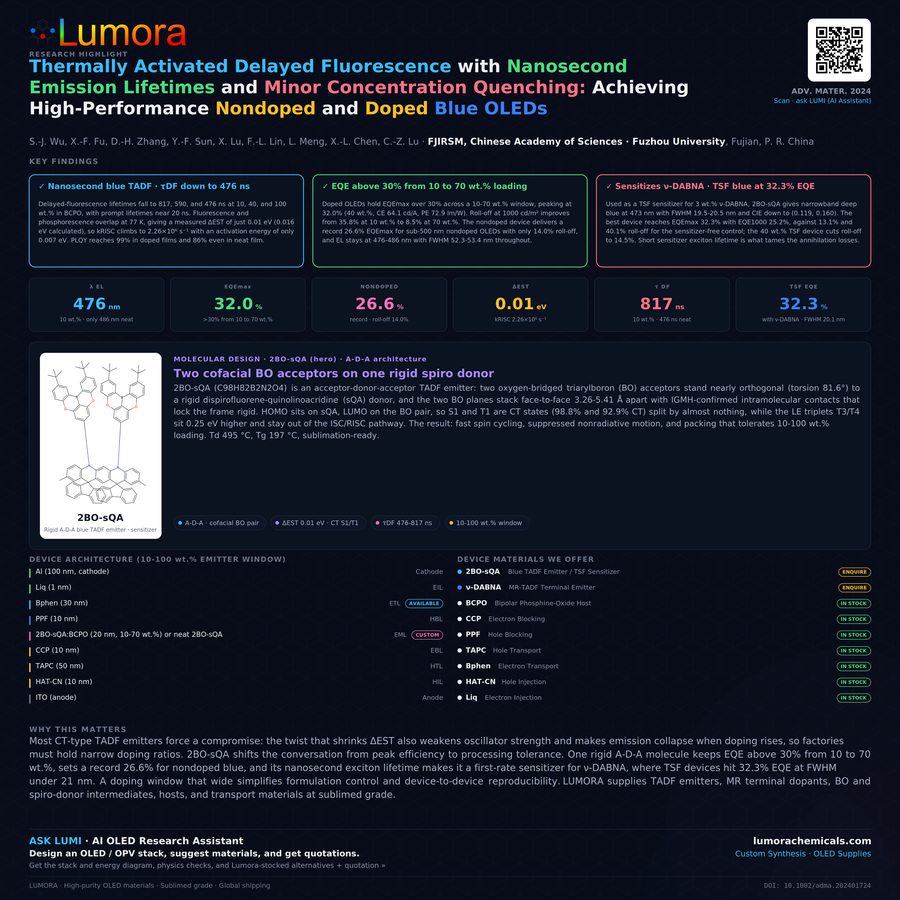
At LUMORA, one of the hardest OLED materials problems is balancing three targets at once: high efficiency, very short exciton lifetime, and tolerance to high emitter concentration. Conventional D-A TADF designs often force trade-offs among these goals. Wu et al. show that a rigid three-dimensional A-D-A architecture can soften that trade-off by combining near-zero singlet-triplet splitting with a concentration-stable solid-state packing motif.
The Problem: Fast TADF Usually Sacrifices Something
Most TADF emitters need highly twisted donor-acceptor structures to reduce ΔEST and support reverse intersystem crossing, but that often lowers oscillator strength, broadens emission, and increases concentration sensitivity. In practical OLED stacks, many CT-type TADF materials also require low doping to avoid quenching, redshift, and device-to-device process variability. The result is a difficult compromise: faster spin conversion often comes with poorer color purity, weaker photoluminescence, or worse manufacturability.
The Breakthrough: A Rigid 3D A-D-A Architecture
The molecule 2BO-sQA combines a rigid dispirofluorene-quinolinoacridine donor with two oxygen-bridged triaryl-boron acceptors in a symmetric A-D-A arrangement. The donor and acceptors are nearly orthogonal, with D-A torsion angles of 81.6°, while the two BO acceptors lie face-to-face and show intramolecular interactions that reinforce rigidity. This gives a CT-type S1/T1 pair with an exceptionally small calculated ΔEST of 0.016 eV, while still suppressing nonradiative motion and concentration quenching. Importantly, the authors conclude that the higher-lying LE triplet states do not directly mediate ISC/RISC, despite their large SOC with S1; the fast spin conversion instead tracks the near-zero S1-T1 gap.
Emitter Platform: IUPAC Names
Key Results
Why This Matters for OLED Material Supply
For LUMORA, this paper is important because it shifts the conversation from single-point peak efficiency to processing tolerance. A TADF emitter that works from 10 wt% doping all the way to neat film reduces formulation sensitivity and can simplify manufacturing control. The design also points to commercial opportunities across high-purity boron-oxygen acceptor intermediates, rigid spiro donor scaffolds, host materials such as BCPO, and sensitizer-dopant combinations for deep-blue TSF stacks. In practical terms, 2BO-sQA is not only an emitter platform but also a robust high-concentration sensitizer platform.
LUMORA, research to pilot
High purity sublimed emitters, hosts and transport materials, with a certificate of analysis on every lot.
Visit LUMORA →Custom synthesis and supply
Gram to production scale, custom synthesis of new emitters, and full CRDMO support. NDA first.
Open LUMI workspace →Partner with us