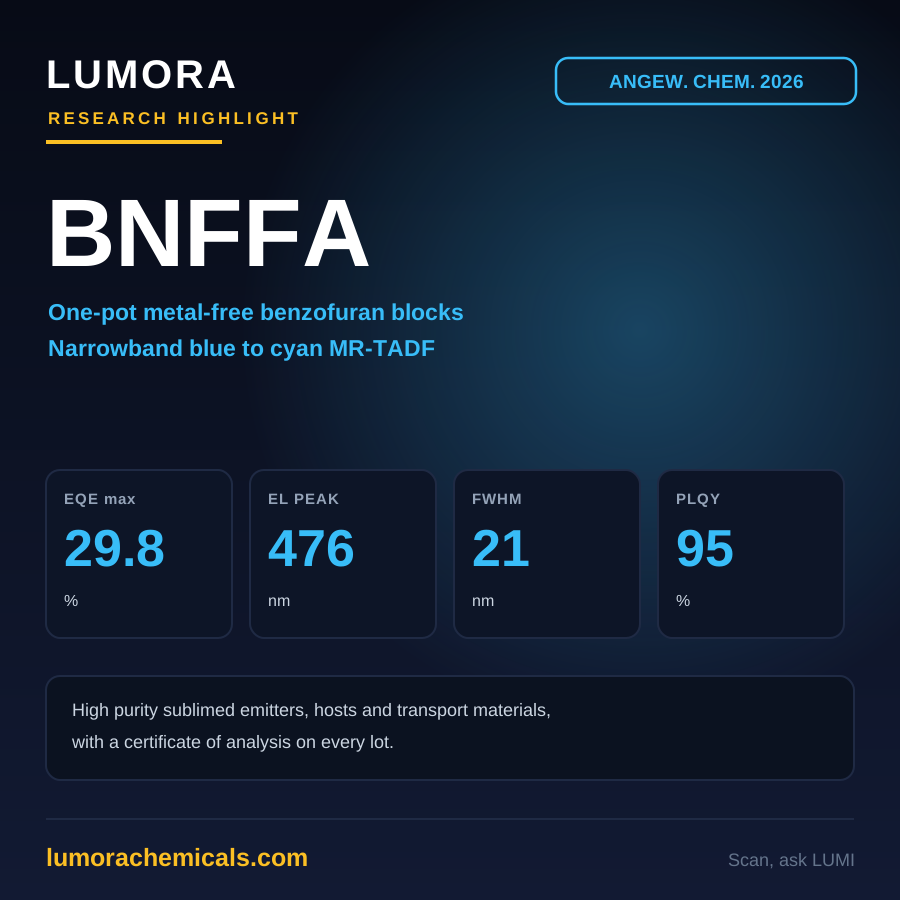
At LUMORA, we value synthetic platforms that make rigid heteroaromatic building blocks more accessible and translate them into efficient display materials. Huang et al. report an amino-group-directed, metal-free one-pot route to fused benzofuran derivatives. These building blocks underpin two MR-TADF emitters, BNFFA and BNFFC, combining narrowband blue–cyan emission, high film photoluminescence quantum yield, and OLED efficiencies approaching 30%.
The Problem: Building-Block Synthesis Limits Emitter Discovery
Benzofuran-containing fused aromatics provide rigid, oxygen-containing donor fragments that can restrict excited-state relaxation and preserve color purity. However, conventional access often requires palladium- or copper-catalyzed coupling, specialized ligands, and multistep precursor preparation. Simpler access to these motifs could broaden the molecular design space for multiple-resonance thermally activated delayed fluorescence (MR-TADF), including complementary blue and cyan emitters for prospective four-primary displays.
The Breakthrough: Acid-Promoted Cyclization in One Operation
The authors combine α-diketones with diarylamines under acidic conditions to construct fused benzofuran frameworks. Optimized conditions use N-methyl-2-pyrrolidone at 200 °C, p-toluenesulfonic acid, and a 1.5:1:3 amine:diketone:acid ratio. The transformation completes within 1.5 h, covers about 20 derivatives with typical scope yields of 36–66%, and provides representative products on a 20 mmol scale in yields close to 70%.
The proposed mechanism involves sequential intermolecular Friedel–Crafts-type addition and intramolecular cyclization; intermediates were not directly observed. The resulting donors are incorporated into B/N MR frameworks to produce BNFFA and BNFFC. Importantly, “metal-free” describes the benzofuran-building-block step, not the entire emitter synthesis, which subsequently uses palladium-catalyzed transformations and lithiation/borylation chemistry.
Key Results
Host Choice Controls Color Purity and Efficiency
DMIC-TRZ-based devices achieve EQEmax values of 23.5% for BNFFA and 29.3% for BNFFC, but increasing loading broadens the spectra; BNFFC develops a long-wavelength band near 570 nm attributed to aggregation. The bulky SiTrzCz2 host improves spatial isolation, reducing broadening and suppressing this additional emission.
Table 1 keeps the loading-dependent results distinct: BNFFA’s 29.8% EQE device has a maximum luminance of 13,934 cd m⁻². BNFFC’s 28.8% EQE device reaches 34,494 cd m⁻²; a separate 1 wt% BNFFC device reaches 41,332 cd m⁻² but only 21.5% EQE. These tabulated values avoid combining peak efficiency and brightness from different devices. DMIC-TRZ offers TADF-assisted triplet recycling, whereas SiTrzCz2 prioritizes steric isolation; host–guest energy transfer and charge balance remain important in both systems.
Why This Matters for OLED Material Supply
For LUMORA, the work connects accessible heteroaromatic synthesis with practical MR-TADF design. The one-pot route expands the supply of benzofuran donor intermediates, while the OLED study highlights the need to match rigid emitters with hosts that control aggregation and carrier balance. Cyan should be viewed here as an additional spectral design opportunity, not a replacement for established RGB primaries or a demonstrated complete four-primary display.
Relevant research and development material categories include α-diketones, diarylamines, substituted benzofuran and carbazole intermediates, p-toluenesulfonic acid, coupling/borylation reagents, and DMIC-TRZ or SiTrzCz2 hosts. These categories indicate potential supply relevance, not confirmed LUMORA product availability. The central lesson is that a simpler building-block route can accelerate emitter discovery, but final color purity and efficiency still depend on host selection and optimized doping concentration.
sales@lumorachemicals.com
lumorachemicals.com
LUMORA, research to pilot
High purity sublimed emitters, hosts and transport materials, with a certificate of analysis on every lot.
Visit LUMORA →Custom synthesis and supply
Gram to production scale, custom synthesis of new emitters, and full CRDMO support. NDA first.
Open LUMI workspace →Partner with us