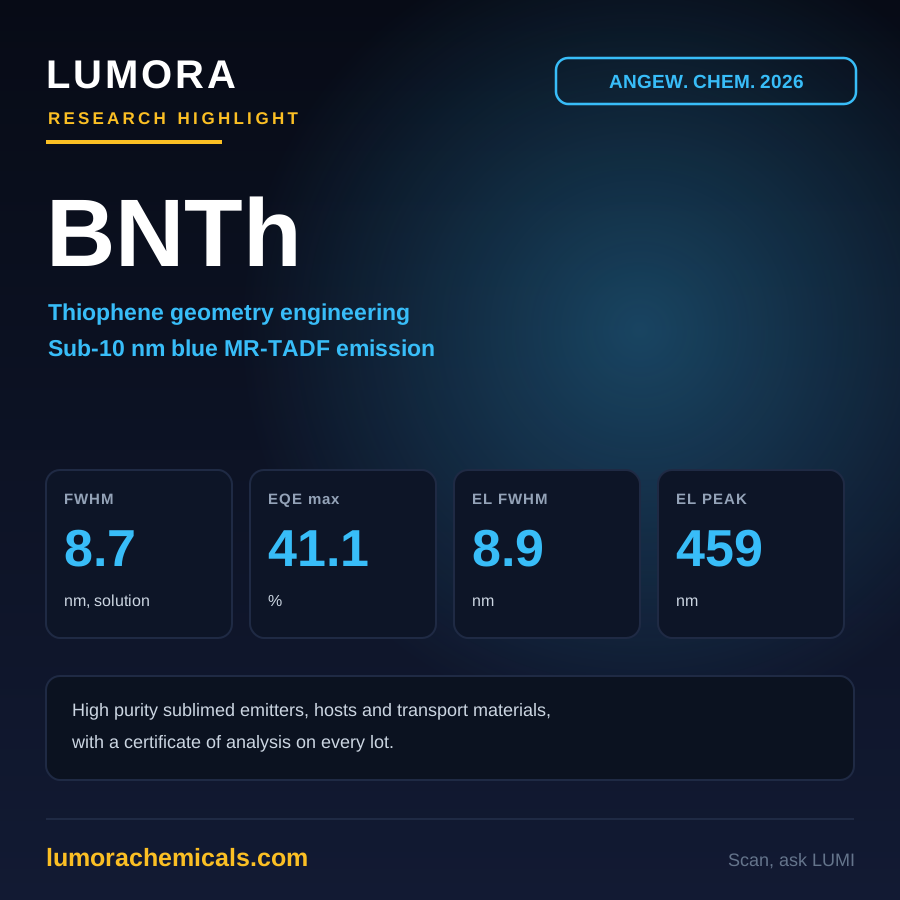
At LUMORA, we focus on molecular strategies that improve color purity without creating an impractical synthesis or compromising device compatibility. This study introduces a compact thiophene-engineering approach for diboron multi-resonance TADF (MR-TADF) emitters. Replacing peripheral six-membered arenes with five-membered thiophenes relieves cove-region hydrogen–hydrogen repulsion, planarizes the MR skeleton, and suppresses the low-frequency vibrations responsible for spectral broadening. The resulting α-BNTh emitters produce near-unity PLQY and solution bandwidths as narrow as 8.7 nm, while retaining exceptionally narrow emission in OLEDs.
The Problem: Narrowing MR-TADF Emission Often Requires Larger, Harder-to-Make Structures
MR-TADF emitters are leading candidates for high-color-purity OLEDs because their short-range charge-transfer excited states naturally reduce structural relaxation. However, pushing emission bandwidths toward or below 10 nm often depends on extending or rigidifying the π-framework. That can increase molecular weight, complicate synthesis, disrupt the target blue color, and create solid-state compatibility challenges.
The benzene-fused diboron reference framework, DBA-Ph, also suffers from severe hydrogen–hydrogen repulsion in its cove region. Its H···H distance of 1.848 Å forces an out-of-plane distortion of 9.1°, activating low-frequency twisting and shearing vibrations that broaden the emission spectrum.
The Breakthrough: Thiophene Fusion Accommodates Atom Repulsion
The authors replace peripheral benzene rings with compact thiophenes. In the optimized α-borylated thiophene framework, α-DBA-Th, cove-region H···H repulsion is eliminated, producing a near-planar molecular skeleton. The low-frequency Huang–Rhys factor falls from 0.83 for DBA-Ph to 0.13 for α-DBA-Th, while the calculated ground-to-excited-state RMSD decreases from 0.100 Å to 0.021 Å.
This geometric accommodation suppresses vibronic coupling without requiring a much larger rigid framework. Importantly, the photophysically optimal α-borylation topology follows thiophene’s inherent electrophilic-borylation preference, enabling an efficient bora-Friedel–Crafts cyclization route. The key α-BNTh-Me intermediate is obtained in 93% yield, whereas the disfavored β-borylated isomer forms in only 2% yield.
Key Results
Why This Matters for OLED Material Supply
For LUMORA, this paper establishes heterocycle engineering as an alternative to simply enlarging MR scaffolds. The α-BNTh platform demonstrates that a smaller five-membered thiophene can simultaneously reduce steric strain, sharpen the spectrum, preserve blue-range color, and align with a high-yield regioselective borylation route.
Relevant supply opportunities include thiophene-based aromatic precursors, mesityl-protected amine intermediates, boron trihalide and bora-Friedel–Crafts reagents, Suzuki coupling and cyanation building blocks, high-triplet-energy SiTrzCz2 host material, and multilayer OLED transport materials including HATCN, TAPC, TCTA, mCP, Na-An-Bi, Liq, and Al. The key commercial message is that α-BNTh combines a synthetically accessible core with ultra-narrowband, near-unity-PLQY, high-EQE OLED performance, an attractive platform for next-generation high-gamut blue display materials.
LUMORA, research to pilot
High purity sublimed emitters, hosts and transport materials, with a certificate of analysis on every lot.
Visit LUMORA →Custom synthesis and supply
Gram to production scale, custom synthesis of new emitters, and full CRDMO support. NDA first.
Open LUMI workspace →Partner with us