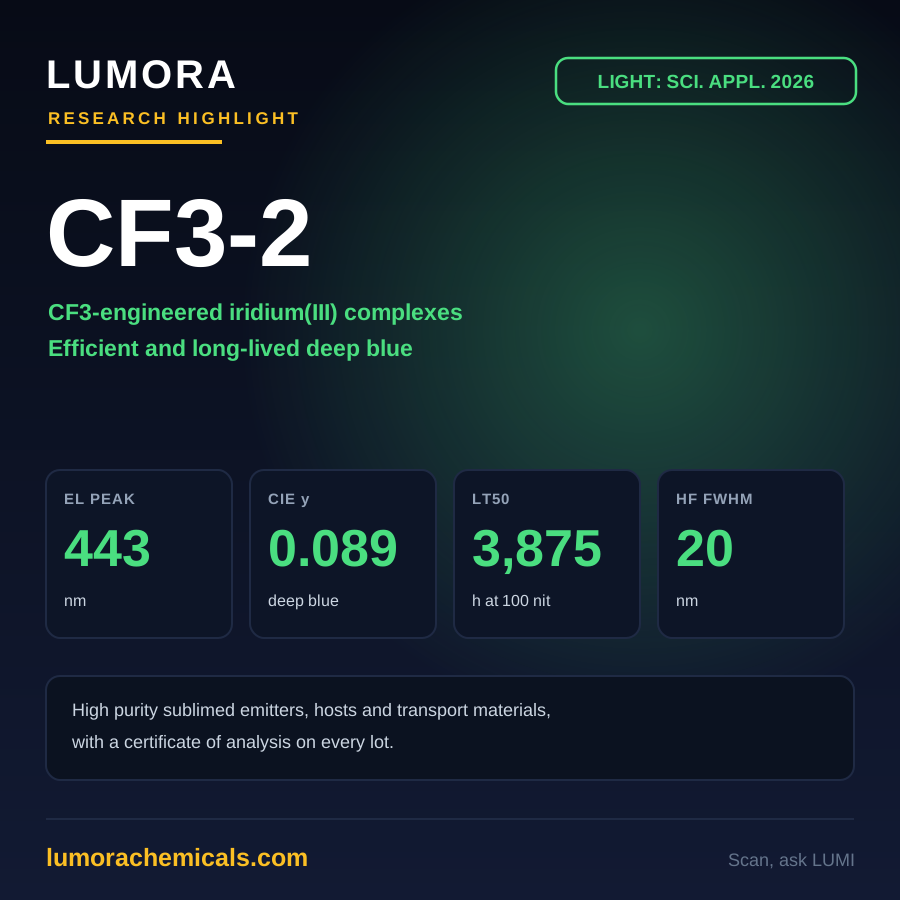
At LUMORA, deep-blue OLED development requires simultaneous control of emission energy, radiative speed, efficiency roll-off, and operational stability. Conventional deep-blue phosphorescent emitters often lose efficiency at practical brightness because triplet excitons accumulate and undergo annihilation. This study shows how precise ligand-level control of charge-transfer character in an asymmetric Ir(III) complex can speed radiative decay, improve charge balance, and support both direct PhOLED and hyperfluorescence display architectures.
The Challenge: Deep Blue Must Be Efficient and Stable
Deep-blue OLED emitters must deliver saturated color while operating efficiently at display brightness and preserving long lifetime. Many conventional symmetric Ir(III) phosphors have limited maximum EQE and substantial roll-off. Faster radiative decay is especially valuable because it reduces the time triplet excitons remain vulnerable to triplet–triplet annihilation, concentration quenching, and other non-radiative losses.
The authors address this through asymmetric 3:2:1 coordination: a rigid tridentate NHC ligand is paired with a modified C,C-bidentate ligand. Adding CF₃ or F to the carbene-containing ligand tunes the frontier orbitals and triplet-state electronic character while maintaining the steric protection and high ligand-field strength needed for deep-blue phosphorescence.
The Breakthrough: CT-State Engineering with CF₃
The central design principle is that CF₃ and F substituents do more than change emission wavelength. CF₃-containing complexes, CF₃-1 to CF₃-3, have predominantly CT excited states, whereas F-1 to F-3 are mainly LE-state emitters. CT character increases the transition dipole moment from T1 to S0 and thereby promotes faster radiative decay.
For the lead compound CF₃-2, the calculated T1→S0 transition dipole moment is 0.74 Debye, the largest in the reported series, and it is associated with the largest radiative decay rate, 1.28 × 10⁶ s⁻¹ in a 12.5 wt% CzSi film. Its short 0.66 μs film lifetime and high 83.8% PLQY help limit exciton accumulation. The bulky CF₃ motif also weakens intermolecular stacking relative to the F-based analogues, helping mitigate aggregation and concentration quenching.
Key Results
Why This Matters for OLED Material Supply
For LUMORA, the work provides a practical blueprint for deep-blue phosphorescent and hyperfluorescent materials development. The relevant supply chain includes high-purity Ir(III) precursors, tridentate NHC ligands, CF₃- and F-functionalized bidentate carbene intermediates, cyanation reagents, high-triplet-energy CzSi host, DPEPO and TSPO1 electron-side materials, and MR-TADF terminal emitters such as ν-DABNA or DOB2-DABNA-A.
The larger strategic lesson is that CF₃-mediated CT-state design can reconcile several normally competing needs: sufficiently deep blue color, short triplet lifetime, high radiative rate, strong EQE, and long lifetime. The direct CF₃-1 control device establishes impressive intrinsic material durability, while the CF₃-1/ν-DABNA hyper-OLED and CF₃-2/DOB2-DABNA-A system illustrate how emitter–sensitizer pairing can be tuned separately for lifetime or more saturated deep-blue color.
LUMORA, research to pilot
High purity sublimed emitters, hosts and transport materials, with a certificate of analysis on every lot.
Visit LUMORA →Custom synthesis and supply
Gram to production scale, custom synthesis of new emitters, and full CRDMO support. NDA first.
Open LUMI workspace →Partner with us