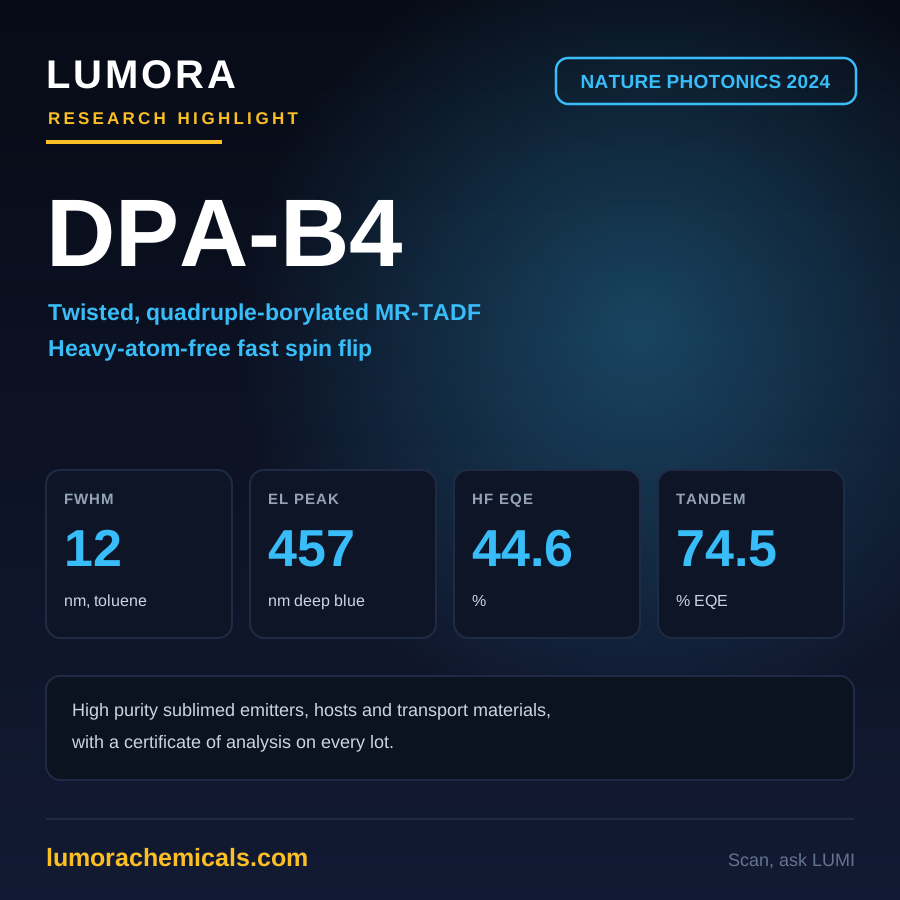
At LUMORA, deep-blue display materials must achieve a difficult balance: a low CIE y and ultranarrow spectrum for wide color gamut, rapid triplet upconversion for low roll-off, and high photoluminescence efficiency for practical brightness. Conventional MR-TADF molecular extension can improve linewidth and reduce ΔEST, but it commonly redshifts emission and slows reverse intersystem crossing. This work presents a molecular-design route that overcomes these tradeoffs without relying on heavy atoms.
The Challenge: Deep Blue Needs Purity and Speed
The BT.2020 blue primary is specified at CIE (0.131, 0.046), demanding an emitter with a suitable blue peak, an extremely narrow, nearly Gaussian spectrum, and minimal spectral tailing. Standard donor–acceptor TADF and phosphorescent emitters can harvest triplets efficiently but often broaden due to structural relaxation and vibrational coupling. Many extended MR-TADF emitters reduce ΔEST below 0.1 eV but have weak spin–orbit coupling and kRISC values of only 104–105 s−1, which leads to high-brightness efficiency loss.
The Breakthrough: Twist plus Fully Resonating Extension
The authors start from DPA-B2, a distorted B,N,B-doped [4]helicene MR core whose non-planarity creates enhanced spin–orbit coupling. They extend it with one or two rigid B/N/O-embedded triangulene units to create DPA-B3 and DPA-B4. Oxygen is used to limit redshift because it contributes less strongly to π-conjugation than nitrogen. The resulting DPA-B4 combines a linearly extended, low-exchange-energy MR scaffold with retained twisted helicene regions, giving a small ΔEST and substantial couplings to nearby triplet states for rapid RISC.
Emitters – DPA-B2, DPA-B3, DPA-B4, Cz-B4
Key Results
Why This Matters for OLED Material Supply
For LUMORA, this paper maps a compelling deep-blue MR-TADF materials platform: precise multi-borylation chemistry, B/N/O-embedded triangulene extensions, twisted helicene-forming cores, and high-purity host–sensitizer systems. DPA-B4 shows that partial non-planarity should not automatically be treated as a spectral-purity penalty; when paired with a fully resonating, non-bonding extended scaffold, twisting can accelerate RISC while the expanded rigid core preserves an ultrasharp band. The accompanying supply opportunity includes boron-containing precursors and borylation reagents, B/N/O-fused MR intermediates, SiTrzCz2 and DBFPO hosts, mMDBA-DI sensitizer, and multilayer OLED transport and blocking materials for high-efficiency single-unit and tandem display stacks.
LUMORA, research to pilot
High purity sublimed emitters, hosts and transport materials, with a certificate of analysis on every lot.
Visit LUMORA →Custom synthesis and supply
Gram to production scale, custom synthesis of new emitters, and full CRDMO support. NDA first.
Open LUMI workspace →Partner with us