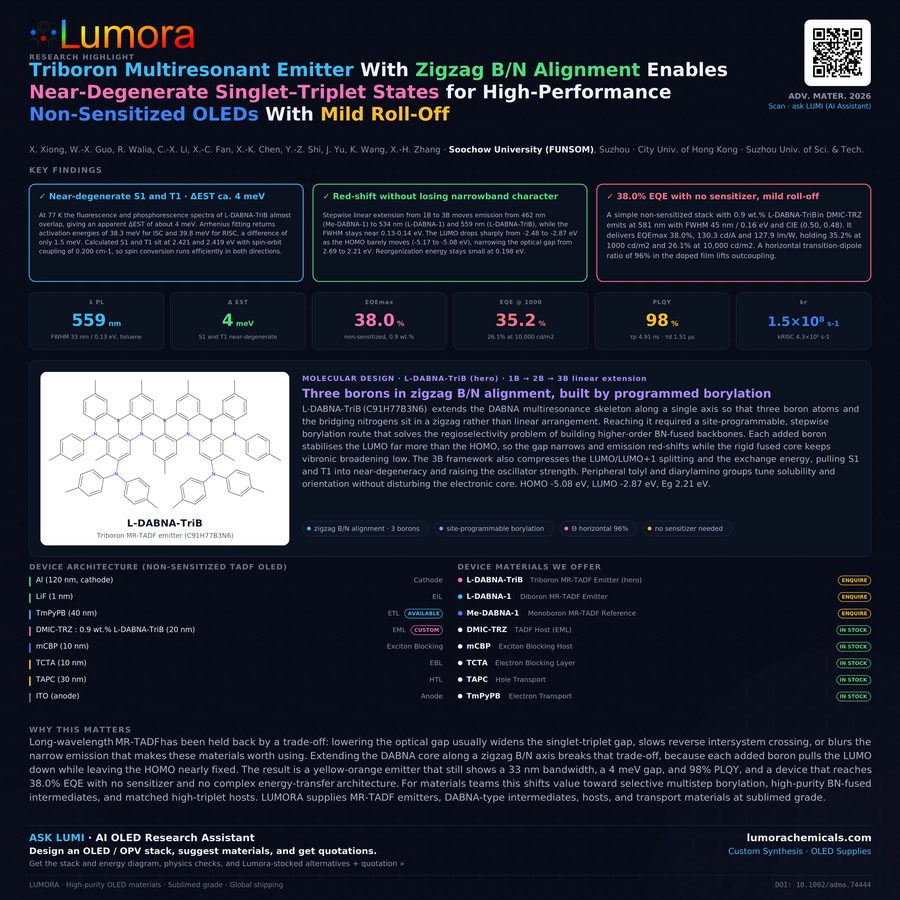
Highlight: Xiong et al. introduce L-DABNA-TriB, a π-extended, triple-boron multiresonance TADF emitter designed through zigzag B-N alignment. Extending the BN-fused DABNA framework from one to three boron atoms lowers the bandgap while preserving narrowband emission, increasing oscillator strength, and bringing S1 and T1 to near degeneracy. L-DABNA-TriB emits at 559 nm with a 33 nm FWHM, 98% PLQY, a near-zero ΔEST of about 4 meV, and fast radiative decay. In a non-sensitized OLED, it reaches 38.0% EQEmax, retains 35.2% at 1000 cd m−2 and 26.1% at 10 000 cd m−2, with 581 nm EL and a 45 nm bandwidth.
At LUMORA, long-wavelength MR-TADF development matters because red-shifting an emitter usually lowers energy efficiency or broadens the spectrum. This work shows a compelling alternative: carefully directed zigzag BN-aligned linear extension can move a DABNA-type platform into yellow-orange emission while simultaneously preserving spectral precision and accelerating triplet harvesting.
The Problem: Red-Shifted MR-TADF Often Loses Efficiency
Conventional strategies for moving MR-TADF emission toward green, yellow, orange, and red commonly encounter a trade-off between a reduced optical gap and efficient TADF kinetics. Lowering the singlet energy can widen the singlet-triplet gap, slow reverse intersystem crossing, or weaken fluorescence. These losses are particularly damaging at high brightness, where slow triplet management raises exciton density and drives efficiency roll-off.
The Breakthrough: Zigzag B-N Linear Extension from 1B to 3B
The authors compare a single-boron reference, Me-DABNA-1, a double-boron analogue, L-DABNA-1, and the new triple-boron emitter L-DABNA-TriB. Adding boron atoms along a zigzag BN-aligned fused backbone substantially stabilizes the LUMO while only modestly shifting the HOMO, narrowing the gap and red-shifting emission. At the same time, the 3B architecture lowers the exchange energy, compresses the LUMO/LUMO+1 separation, enhances multiconfigurational stabilization of S1, and increases spin-orbit coupling. Crucially, the rigid MR framework retains low reorganization energy, so the red shift does not erase narrowband behavior.
Emitter Platform: From 1B to 3B
Key Results (Short)
Why This Matters for OLED Material Supply
For LUMORA, L-DABNA-TriB demonstrates a commercially relevant pathway from DABNA-like blue emitters to high-efficiency yellow-orange MR-TADF materials. The important enabling elements are not limited to the final emitter: selective multistep borylation chemistry, high-purity BN-fused intermediates, controlled peripheral substituents, and compatible high-triplet-energy host materials are all central to reproducing this performance. Because the OLED is non-sensitized and still achieves 38.0% EQE, the work also reduces dependence on a more complex sensitizer-dopant energy-transfer architecture. This is a strong molecular-design reference for high-color-purity, long-wavelength display and lighting materials.
LUMORA, research to pilot
High purity sublimed emitters, hosts and transport materials, with a certificate of analysis on every lot.
Visit LUMORA →Custom synthesis and supply
Gram to production scale, custom synthesis of new emitters, and full CRDMO support. NDA first.
Open LUMI workspace →Partner with us