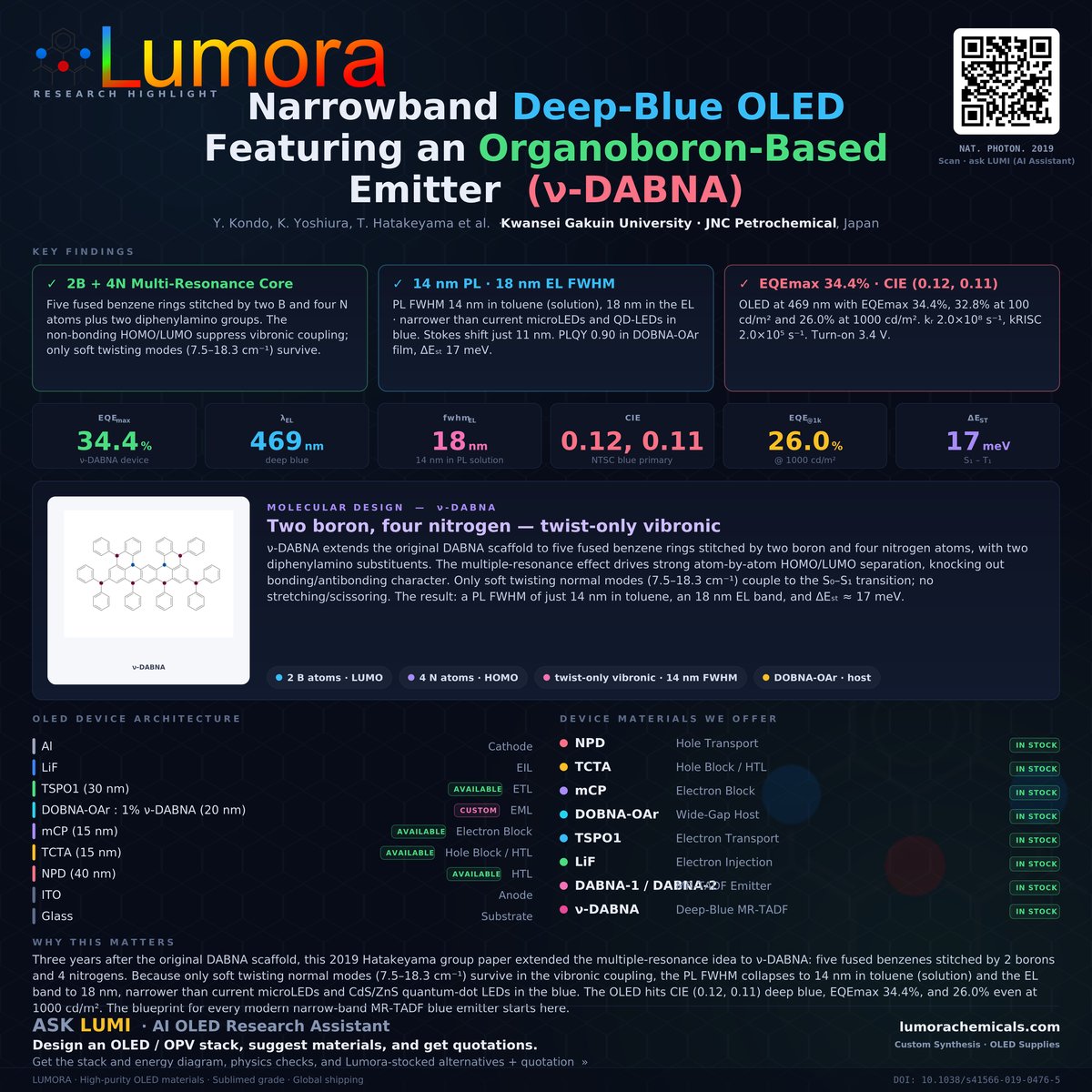
Narrowband Deep-Blue OLED Featuring an Organoboron-Based Emitter: A Record-Breaking Achievement
Kondo, Yoshiura, Hatakeyama et al., Nature Photonics, 2019- "Narrowband deep-blue organic light-emitting diode featuring an organoboron-based emitter."
At LUMORA, we track the breakthroughs that redefine what is possible in OLED materials science. This landmark 2019 paper in Nature Photonics by Prof. Takuji Hatakeyama's group at Kwansei Gakuin University, in collaboration with JNC Petrochemical Corporation, introduced ѵ-DABNA, a next-generation MR-TADF emitter that shattered prior records for color purity and efficiency in blue OLEDs and remains a defining reference in narrowband organic emitter design.
The Problem: Vibronic Coupling Limits Color Purity in OLEDs
Even the best OLED displays typically exhibit blue emission spectra with FWHM exceeding 40 nm, far too broad for BT.2020 ultra-high-definition display standards. The root cause is vibronic coupling: in conventional polycyclic aromatic emitters (e.g., perylene), HOMO and LUMO are delocalized between atoms forming pi-bonds. This bonding/antibonding character creates strong stretching vibrations that couple electronic and nuclear motion between S0 and S1 states, broadening the emission spectrum. Competing technologies, micro-LEDs and quantum dot LEDs, achieve ~20 nm FWHM in the blue but suffer from high fabrication costs, poor reproducibility, and limited large-area scalability. OLEDs needed a fundamentally new molecular design to compete.
The Breakthrough: ѵ-DABNA and Non-Bonding Molecular Orbitals
Hatakeyama et al. designed ѵ-DABNA, a polycyclic framework of five benzene rings connected by two boron and four nitrogen atoms with two diphenylamino substituents. The multiple resonance effect of B and N atoms localizes HOMO and LUMO on different atoms, generating non-bonding molecular orbitals. This eliminates bonding/antibonding character, suppresses vibronic coupling and vibrational relaxation at the S1 state, and simultaneously minimizes ∆EST. The result: a photoluminescence FWHM of just 14 nm in solution, the sharpest emission ever reported for an organic emitter, and a ∆EST of only 17 meV for efficient TADF up conversion.
Key Device & Photophysical Results
- PL Emission / FWHM: 468 nm with only 14 nm FWHM in toluene the sharpest organic emitter reported
- EL Emission / FWHM: 469 nm with 18 nm FWHM in device narrower than microLEDs and QD-LEDs (~20 nm)
- PLQY: 90 % in doped film; ∆EST = 17 meV (extremely small)
- OLED EQE: 34.4% maximum; 32.8% at 100 cd/m²; 26.0% at 1,000 cd/m² record for blue OLEDs
- CIE coordinates: (0.12, 0.11) approaching NTSC standard (0.14, 0.08); no color filter required
- Thermal stability: No degradation up to 440°C C-N bond strength comparable to standard OLED transport materials
Why This Matters for the OLED Materials Supply Chain
The nu-DABNA device stack (ITO / NPD / TCTA / mCP / ѵ-DABNA: DOBNA-OAr / TSPO1 / LiF / Al) introduced DOBNA-OAr as a new high-performance bipolar host uniquely matched to the MR-TADF emitter, a key addition to the OLED materials ecosystem. Since this 2019 publication, ѵ-DABNA has become the benchmark reference for narrowband blue MR-TADF emitters, inspiring a generation of structural derivatives now achieving EQEs beyond 35% and FWHMs below 20 nm for BT.2020-compliant displays. LUMORA supplies ѵ-DABNA, DOBNA-OAr host, and the full suite of charge transport materials to support research teams and manufacturers building on this landmark technology.
Reference: Kondo, Y. et al. Nature Photonics 2019, 13, 678-682. DOI: 10.1038/s41566-019-0476-5
R&D and pilot quantities
We supply the key materials from this study in high-purity sublimed grades, from grams to kilograms, shipped worldwide.
Visit LUMORA →Kilogram to production, and custom MR-TADF
For large-scale supply, new emitter synthesis, and CRDMO support, work with LAMKO directly. Scope your project in the LUMI workspace, or send a partnership request.
Open LUMI workspace →Partner with us