Home › Research Highlights › pt-adaph-deep-blue-pholed
ADV. FUNCT. MATER.

Adamantyl-Spaced Tetradentate Pt(II) Complexes Enable Highly Efficient Deep-Blue Phosphorescent OLEDs

📅 August 26, 2026Huh et al., Advanced Functional Materials, 2021 , “Highly Efficient Deep-Blue Phosphorescent OLEDs Based on Tetradentate Pt(II) Complexes”
Adamantyl-Spaced Tetradentate Pt(II) Complexes Enable Highly Efficient Deep-Blue Phosphorescent OLEDs

At LUMORA, deep-blue phosphorescent emitters are valuable only when color purity, efficiency, and concentration tolerance can be managed together. This paper is notable because it does not rely solely on changing the emissive core. Instead, it shows that non-conjugating spacer groups around a tetradentate Pt(II) platform can control aggregation and spectral drift without giving up deep-blue color.

The Problem: Deep-Blue Pt(II) Emitters Tend to Interact in Films

Deep-blue phosphorescent OLEDs are difficult because metal-complex emitters can broaden, red-shift, or form excimer-like states as doping concentration increases. Even when the molecular core is intrinsically blue, intermolecular dipole-dipole interactions and packing effects can degrade spectral purity. The challenge is therefore not just generating blue emission, but preserving it under realistic thin-film and device conditions.

The Breakthrough: Spacer-Group Engineering on a Distorted Tetradentate Core

The authors build four Pt(II) complexes on the same tetradentate framework and vary the spacer environment: no spacer in Pt-R, adamantyl in Pt-Ada, phenyl-adamantyl in Pt-AdaPh, and tolyl-adamantyl in Pt-AdaTol. DFT shows distorted coordination geometries with dihedral angles near 17° for all four complexes, which already helps suppress parallel stacking and excimer formation. The out-of-plane adamantyl-based groups increase steric bulk and intermolecular distance, reducing concentration-driven spectral changes; phenyl and tolyl substitution further tunes the bandgap by extending conjugation indirectly through the spacer.

Emitter Platform: IUPAC Names

Key Results

Deep-blue phosphorescence with narrow vibronic structure All four emitters show λPL around 455 nm in doped films with FWHM values of about 40 nm. The relative 0-1 to 0-0 vibronic intensity stays around 0.5, supporting deep-blue emission with controlled spectral broadening.
Spacer groups reduce concentration sensitivity No new excimer peaks appear as doping increases, but Pt-R shows a larger increase in the 0-1 vibronic contribution than Pt-AdaTol. This indicates that the adamantyl-based spacer groups reduce intermolecular interactions and suppress concentration-induced spectral distortion.
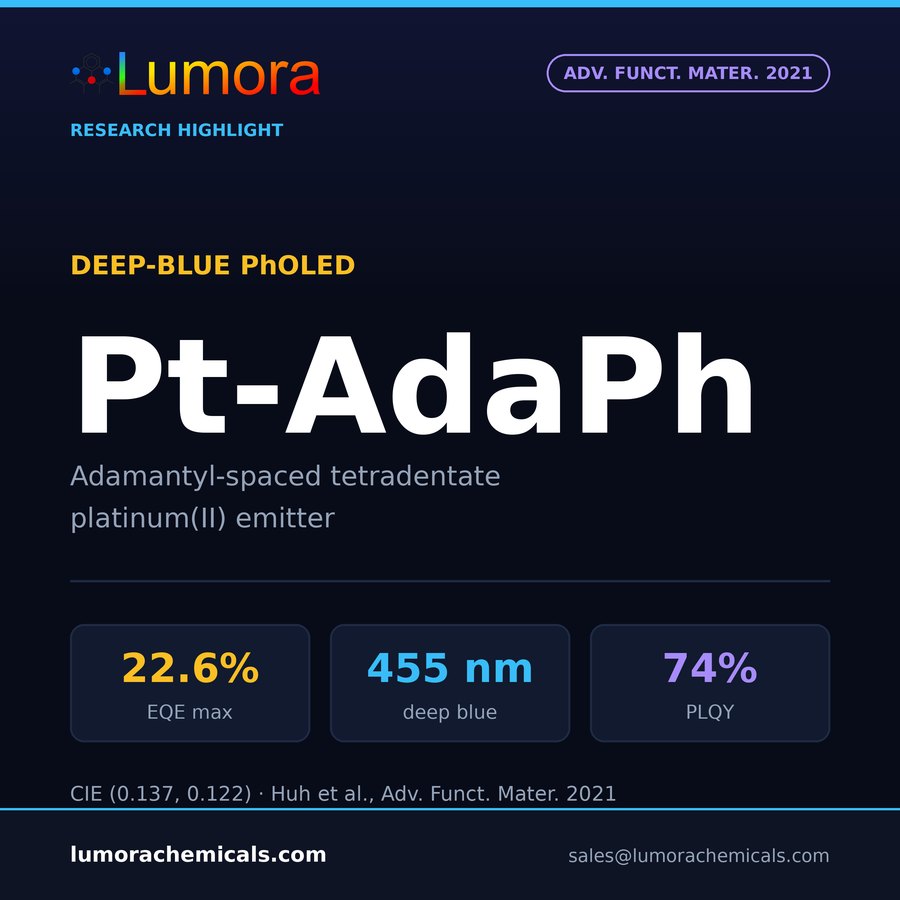
Best emitter Pt-AdaPh: Pt-AdaPh combines the highest PLQY in the series, 74%, with a 2.45 μs lifetime and the strongest OLED performance. Its device reaches 22.6% EQEmax, 23.5 cd A−1 CEmax, and deep-blue CIE (0.137, 0.122).
Excellent color purity and stability All OLEDs maintain CIE y values at or below 0.122, and voltage-dependent color drift is very small from turn-on to 12 V. This is a strong result for deep-blue phosphorescent devices, where color often shifts noticeably under operation.
Brightness can be increased by transport-layer tuning For Pt-AdaPh, increasing MoO3 doping lowers Von from 4.2 to 3.6-3.7 V and raises luminance from 1561 to as high as 4528 cd m−2. The trade-off is a drop in EQE from 22.6% to 19.6%-20.4%, likely due to hole-heavy charge imbalance.

Why This Matters for OLED Material Supply

For LUMORA, this study highlights how peripheral molecular engineering can be just as commercially relevant as core-emitter invention. Adamantyl-based spacers offer a practical route to high-purity deep-blue Pt(II) emitters that are less vulnerable to aggregation, spectral drift, and doping-level sensitivity. The work also reinforces demand for platinum precursors, benzimidazole carbene ligand platforms, carbazolyl pyridine intermediates, and specialized spacer-bearing building blocks that improve vacuum-deposited OLED performance. In supply-chain terms, the lesson is clear: morphology control starts at the molecular design stage.

Reference: Huh, J.-S.; et al. Adv. Funct. Mater. 2021, 31, 2100967. “Highly Efficient Deep-Blue Phosphorescent OLEDs Based on Tetradentate Pt(II) Complexes.”  10.1002/adfm.202100967 →
#OLED #DeepBlueOLED #PtII #PhosphorescentOLED #TetradentatePlatinum #Adamantyl #BluePhosphor #AdvancedFunctionalMaterials #LUMORA
Order the materials

LUMORA, research to pilot

High purity sublimed emitters, hosts and transport materials, with a certificate of analysis on every lot.

Visit LUMORA →
Scale up and CRDMO

Custom synthesis and supply

Gram to production scale, custom synthesis of new emitters, and full CRDMO support. NDA first.

Open LUMI workspace →Partner with us
Educational use notice. The Research Highlights on this site are shared for educational and informational purposes only. We summarise publicly available, published research to make it more accessible. All papers, figures, data, names and trademarks remain the property of their respective authors and publishers, and no ownership of the original work is claimed. If you are an author, publisher or rights holder and have any objection to any content shown here, please contact us at info@lamko.co.kr and we will remove, change or modify the content as per your instructions.