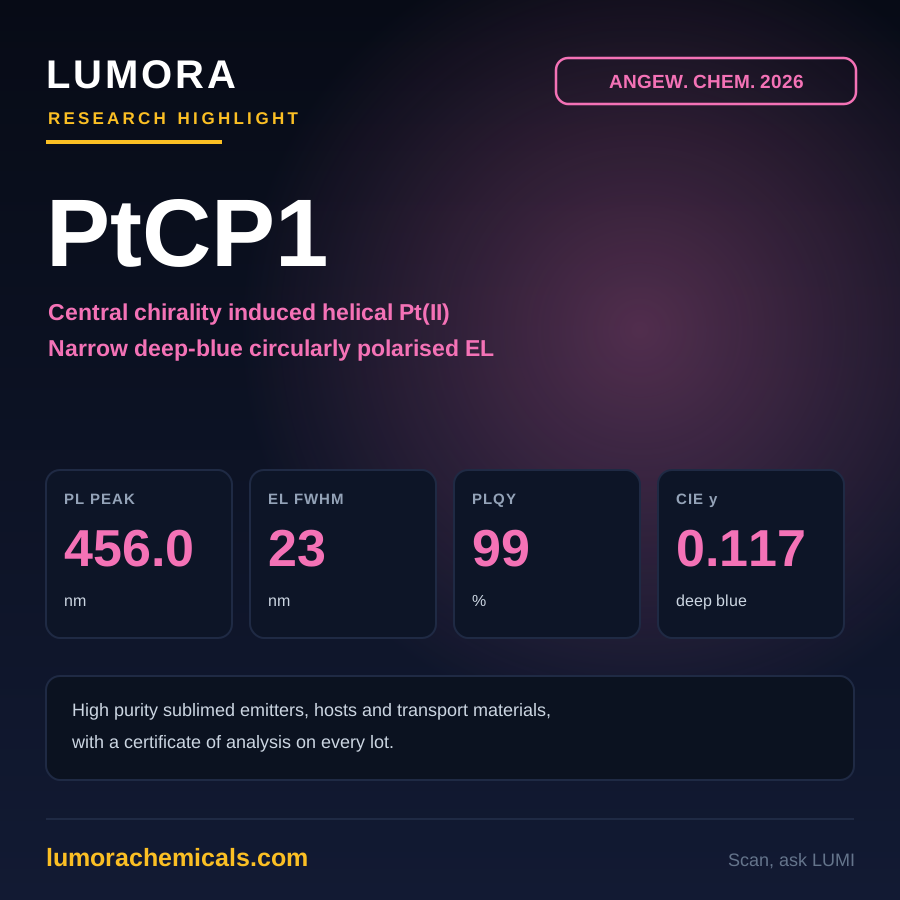
At LUMORA, we value emitter platforms that unite high color purity, efficiency, configurational stability, and scalable synthesis. This study introduces a central-chirality-adaptively-induced helical chirality (CAIH) strategy for tetradentate Pt(II) phosphors. Rather than relying on difficult chiral HPLC separation, the authors use inexpensive, optically pure amino-alcohol building blocks to direct Pt(II) coordination into a single M- or P-helical configuration. The resulting PtCP1 and PtCP2 emitters combine narrow deep-blue circularly polarized luminescence (CPL), high photoluminescence quantum yields, excellent thermal/configurational stability, and efficient vacuum-deposited circularly polarized phosphorescent OLEDs (CP-PhOLEDs).
The Problem: Previous Helically Chiral Pt(II) Emitters Were Difficult to Scale and Often Too Red or Broad
Helically chiral Pt(II) complexes can directly produce circularly polarized phosphorescence, allowing theoretical 100% internal quantum efficiency in CP-OLEDs. However, earlier systems commonly required chiral HPLC resolution, showed thermal racemization during vacuum deposition, emitted in orange to near-infrared regions, or produced broad spectra with FWHM values of roughly 57–110 nm. These limitations made it difficult to combine high optical purity, deep-blue color, narrow bandwidth, high efficiency, low roll-off, configurational stability, and gram-scale preparation in one material platform.
The Breakthrough: Central Chirality Adaptively Induces a Stable Helical Pt(II) Configuration
The CAIH strategy introduces commercially available R- or S-type chiral amino alcohols into the N-heterocyclic carbene (NHC) portion of a tetradentate Pt(II) ligand. During Pt(II) coordination, steric differentiation between the central chiral substituents selectively favors one M- or P-helical arrangement, producing a single diastereomer without chiral HPLC purification.
The central chiral group raises steric hindrance around the Pt coordination plane, while nearly orthogonal diisopropylphenyl groups limit molecular packing and aggregation. Pyridinecarbazole units add locally excited triplet character, enabling deep-blue, narrowband emission. The authors prepare M-/P-PtCP1 from valinol and M-/P-PtCP2 from tert-leucinol in high yield on gram scale; P-PtCP1 is obtained as 5.80 g in 73% yield and P-PtCP2 as 3.68 g in 81% yield.
Key Results
Why This Matters for OLED Material Supply
For LUMORA, this work provides a practical synthesis and design blueprint for circularly polarized blue phosphors. The supply chain opportunity includes optically pure amino alcohols such as valinol and tert-leucinol, chiral NHC precursor chemistry, pyridinecarbazole and diisopropylphenyl intermediates, Pt(COD)Cl₂, cyclometallation reagents, bipolar SiCzCz/SiTrzCz2 host systems, and charge-transport materials including HATCN, TAPC, mSiTrz, Liq, and LiF.
The strategic advance is that chirality, high optical purity, deep-blue color, and vacuum-process compatibility are engineered together rather than treated as separate problems. PtCP1 is the stronger color-purity and peak-efficiency candidate, while PtCP2 shows slightly better high-brightness retention and a longer device LT50 of 14.0 h at an initial 1,000 cd m⁻², compared with 6.9 h for PtCP1. The CAIH approach offers a scalable route toward high-performance circularly polarized display emitters without the bottleneck of chiral chromatographic separation.
LUMORA, research to pilot
High purity sublimed emitters, hosts and transport materials, with a certificate of analysis on every lot.
Visit LUMORA →Custom synthesis and supply
Gram to production scale, custom synthesis of new emitters, and full CRDMO support. NDA first.
Open LUMI workspace →Partner with us