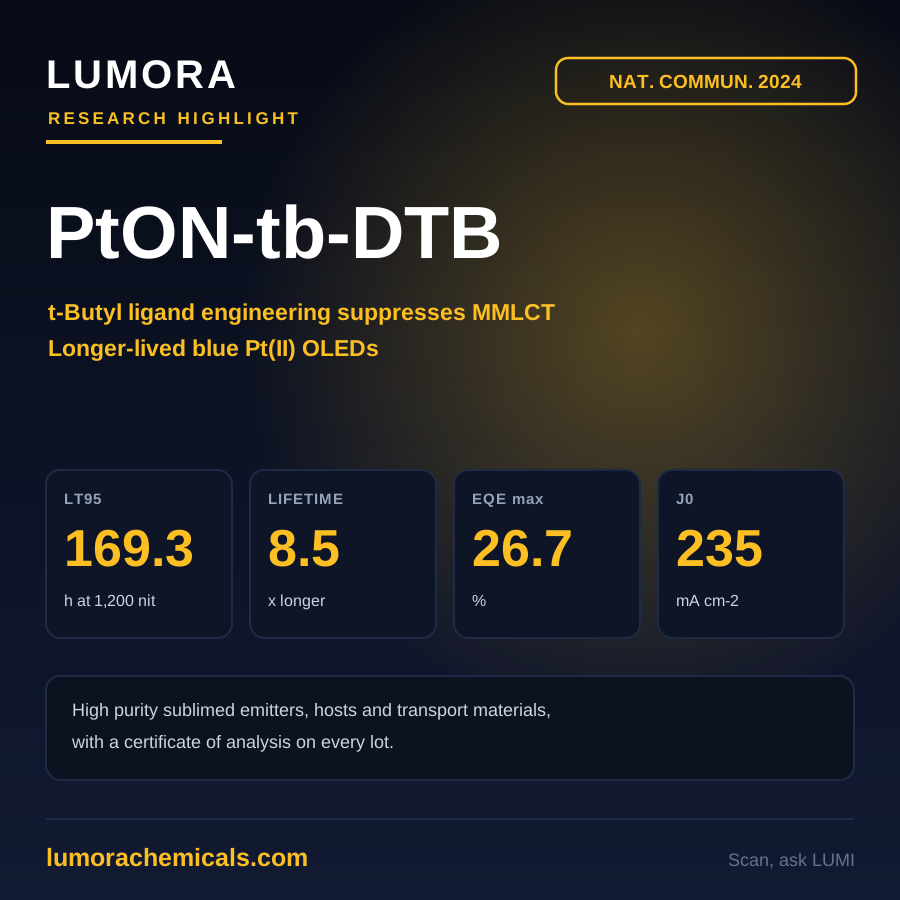
At LUMORA, we focus on emitter designs that improve not only peak efficiency but also the lifetime-limiting photophysical processes that determine real display viability. This Nature Communications study shows how small, deliberate changes to t-butyl substitution on a tetradentate Pt(II) phosphor can suppress metal–metal-to-ligand charge transfer (MMLCT), slow triplet exciton diffusion, reduce triplet–triplet annihilation (TTA), and dramatically improve blue PhOLED lifetime.
The Problem: MMLCT and ³MC States Limit Blue Pt(II) PhOLED Durability
Tetradentate Pt(II) complexes are promising blue phosphorescent dopants because they can combine high exciton utilization with narrow emission and good color quality. However, intermolecular orbital overlap in solid films can form MMLCT-like interactions. These interactions broaden emission, lower photoluminescence quantum yield (PLQY), and promote Dexter energy transfer (DET)-driven triplet diffusion.
At high brightness, triplet diffusion increases TTA. TTA-generated hot excitons can reach the triplet metal-centered, or ³MC, state. The ³MC state is a non-radiative degradation channel: its structural distortion can lead to Pt–N bond weakening and irreversible molecular damage. Therefore, long-lived Pt(II) blue devices must reduce MMLCT formation and enable fast ³MC-to-T1 recovery.
The Breakthrough: Positioning t-Butyl Groups Controls Molecular Packing and Excited-State Geometry
The authors modify the reference complex PtON-TBBI to create PtON-tb-DTB and PtON-tb-TTB. PtON-tb-TTB adds a t-butyl group at the meta position of the ether-linked phenyl ring, while PtON-tb-DTB removes one t-butyl group from the benzimidazolium-carbene-substituted phenyl ring.
The added t-butyl group in PtON-tb-TTB increases intermolecular separation: its calculated number density falls from 0.901 nm⁻³ for PtON-TBBI to 0.811 nm⁻³. PtON-tb-DTB instead controls MMLCT through geometry: its C4–Pt–N2–C5 dihedral angle rises from 15.5° to 20.3° in the T1 state, reducing Pt-centered orbital overlap without a major density change.
Key Results
Why This Matters for OLED Material Supply
For LUMORA, this paper establishes that a robust blue Pt(II) materials platform requires more than maximum PLQY or maximum EQE. Dopant packing, Pt-centered orbital overlap, excited-state dihedral geometry, MMLCT formation, DET-mediated triplet diffusion, TTA rate, ³MC transition barriers, and T1/³MC structural displacement need to be optimized together.
The supply opportunity includes Pt(COD)Cl₂ and related Pt(II) precursors, benzimidazolium-carbene and NHC ligand intermediates, t-butyl-substituted aryl building blocks, pyridyl-carbazole derivatives, cyclometallation reagents, SiCzCz and SiTrzCz co-host materials, PCBBiF hole-transport material, and mSiTrz/Liq/LiF electron-side materials. The practical lesson is that PtON-tb-TTB is the efficiency leader, whereas PtON-tb-DTB is the lifetime leader; future commercial blue PhOLED stacks must balance both pathways rather than optimize a single metric.
LUMORA, research to pilot
High purity sublimed emitters, hosts and transport materials, with a certificate of analysis on every lot.
Visit LUMORA →Custom synthesis and supply
Gram to production scale, custom synthesis of new emitters, and full CRDMO support. NDA first.
Open LUMI workspace →Partner with us