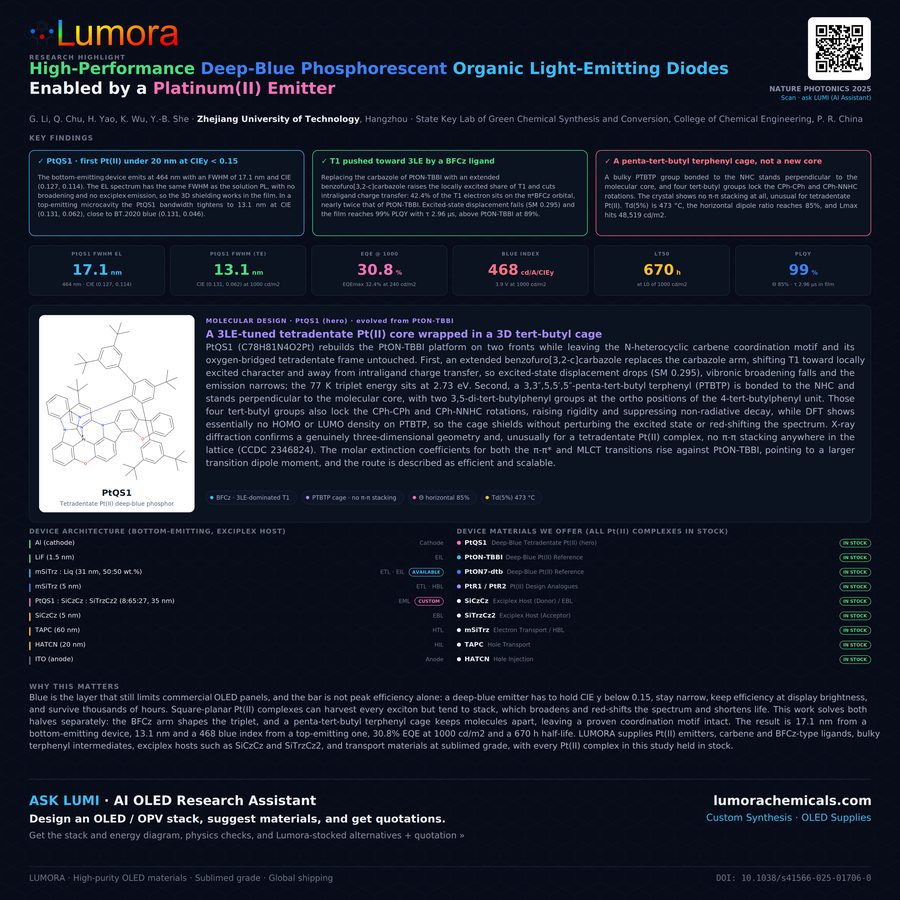
At LUMORA, deep-blue OLED material development is where color purity, brightness, efficiency, and operational lifetime must be optimized simultaneously. Tetradentate platinum complexes can harvest both singlet and triplet excitons, but their square-planar structures often stack in films, causing broad spectra, efficiency roll-off, and degradation. This study offers an integrated emitter-design solution: control the emitting triplet character and physically protect the metal complex from intermolecular interactions.
The Challenge: Blue Pt(II) Emitters Tend to Broaden and Stack
Narrow deep-blue Pt(II) phosphors often exhibit FWHM values above 20 nm and a pronounced vibronic sideband, which reduces color purity. Their two-dimensional square-planar geometry can also encourage Pt-Pt or π-π interactions and guest-host exciplex formation, red-shifting and broadening electroluminescence. A commercially meaningful deep-blue device needs low CIE y, narrow bandwidth, low high-brightness roll-off, and long life, not just high peak efficiency.
The Breakthrough: 3LE State Control plus 3D Steric Protection
PtQS1 introduces two complementary design elements. First, the extended BFCz unit increases the locally excited contribution in the T1 state and reduces interligand charge-transfer character, minimizing excited-state displacement and vibronic broadening while retaining enough metal-ligand charge-transfer character for efficient spin conversion. Second, the perpendicular PTBTP bulky group and tert-butyl-substituted phenyl units create a rigid three-dimensional geometry, eliminating observed intermolecular π-π stacking and restricting rotation without strongly perturbing the core excited state.
Emitter Platform: PtQS1
Key Results
Why This Matters for OLED Material Supply
For LUMORA, this research defines a high-performance materials platform for deep-blue phosphorescent displays: tetradentate Pt(II) complexes tuned toward 3LE-dominated triplet states, extended rigid heteroaromatic ligands, and bulky three-dimensional shielding groups that suppress concentration-dependent interactions. The supporting stack requires high-purity Pt(II) emitter intermediates, N-heterocyclic carbene and BFCz-type ligands, sterically demanding terphenyl building blocks, mixed SiCzCz/SiTrzCz2 host materials, and purpose-designed transport and injection layers. The result is a blue emitter concept that delivers narrow spectrum, unusually high efficiency at display brightness, low voltage, and credible long-term stability in both single-unit and tandem architectures.
LUMORA, research to pilot
High purity sublimed emitters, hosts and transport materials, with a certificate of analysis on every lot.
Visit LUMORA →Custom synthesis and supply
Gram to production scale, custom synthesis of new emitters, and full CRDMO support. NDA first.
Open LUMI workspace →Partner with us