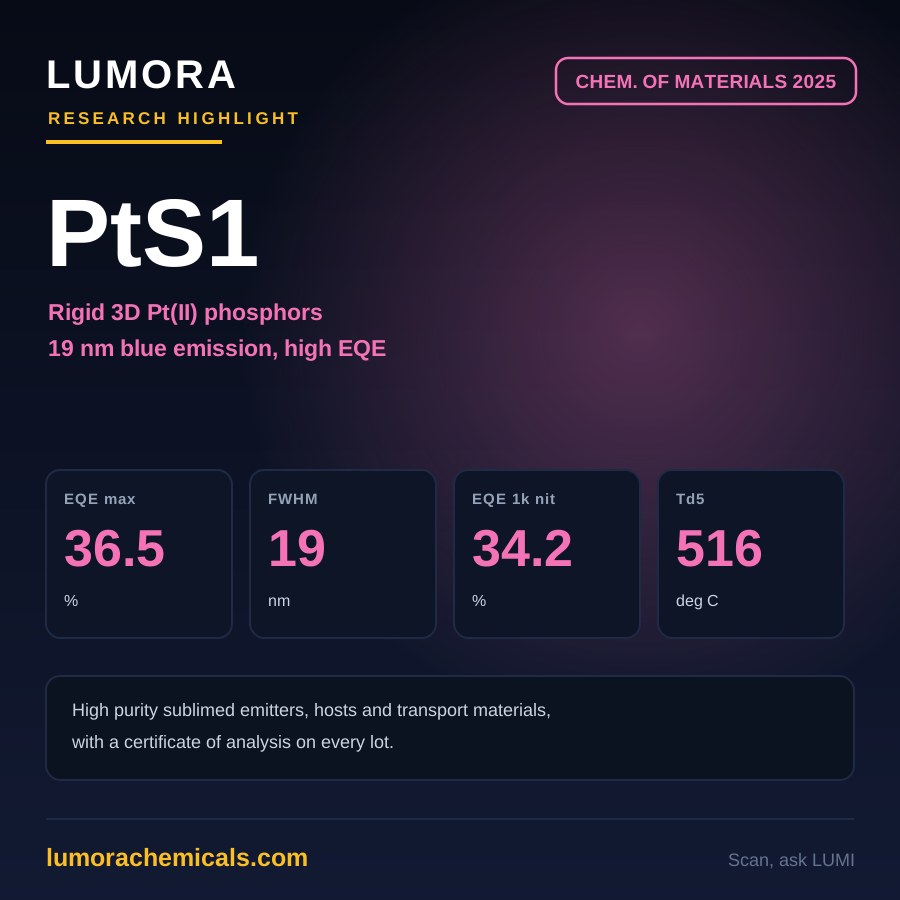
At LUMORA, we value emitter platforms that combine narrow spectral bandwidth with efficiency at practical display brightness. This study introduces two tetradentate Pt(II) phosphors, PtO1 and PtS1, pairing sterically protected three-dimensional geometries with locally excited triplet states. Both retain 19 nm electroluminescence bandwidths in OLEDs. PtS1 delivers the highest peak efficiency, 36.5%, while PtO1 offers better color purity and higher maximum brightness.
The Problem: Planar Pt(II) Emitters Can Broaden and Quench
Tetradentate Pt(II) complexes can harvest singlet and triplet excitons, but their usual square-planar geometry encourages intermolecular stacking and host–guest interactions. These interactions can red-shift and broaden spectra, increase triplet–triplet or triplet–polaron annihilation, and reduce efficiency at high brightness. Strong vibronic sidebands are a further obstacle to color purity. The authors therefore regulate both molecular shape and the electronic character of the emitting triplet state.
The Breakthrough: Steric Shielding plus Triplet-State Engineering
A bulky TBTP terphenyl group is incorporated into a benzo-functionalized N-heterocyclic carbene ligand. Its phenyl groups shield both sides of the emissive core and restrict molecular motion. Extending carbazole with benzofuro[3,2-c]carbazole produces PtO1; using benzothieno[3,2-c]carbazole produces PtS1. Single-crystal analysis shows three-dimensional geometries with no observed intermolecular π–π interactions.
Calculations identify locally excited (³LE)-dominated T1 states mixed with metal-to-ligand charge-transfer (³MLCT) character. The ³LE component supports narrow emission with limited core deformation, while the ³MLCT component supports efficient phosphorescence through spin–orbit coupling. High-triplet-energy SiCzCz/SiTrzCz2 co-hosts enable effective energy transfer to the emitters.
Key Results
Performance Context and Limitations
PtS1 prioritizes peak efficiency and longer device lifetime, whereas PtO1 provides better color purity, brighter maximum output, and slightly lower relative efficiency roll-off. The reported color coordinates should not be described as BT.2020-compliant deep blue. The authors attribute the relatively short operational lifetimes to the instability of the TAPC hole-transport layer, highlighting the need for further stack optimization.
The article contains an internal numerical inconsistency: its conclusion lists PtO1 maximum EQE as 34.2%, while the detailed device-performance discussion gives 32.9%. This summary uses 32.9% from the detailed results. Record-performance claims in the paper apply to the authors’ 2025 literature comparison and specific CIEy categories, not universally to all blue OLEDs.
Why This Matters for OLED Material Supply
For LUMORA, the study illustrates how ligand engineering can preserve narrow phosphorescence while supporting high efficiency at display-relevant brightness. A sterically shielding NHC substituent manages intermolecular interactions, and fused oxygen- or sulfur-containing carbazole units tune the triplet character and emission color. The reported gram-scale synthesis also supports systematic material characterization and device-development work.
Research-relevant material categories include Pt(COD)Cl₂, benzimidazolium/NHC ligand precursors, benzofurocarbazole and benzothienocarbazole intermediates, bulky terphenyl building blocks, coupling reagents, and SiCzCz/SiTrzCz2 co-hosts. HATCN, TAPC, mSiTrz, Liq, and LiF complete the transport and injection stack. These categories indicate potential supply relevance, not confirmed LUMORA product availability. Future development should combine emitter screening with stable transport layers rather than optimizing peak EQE alone.
sales@lumorachemicals.com
lumorachemicals.com
LUMORA, research to pilot
High purity sublimed emitters, hosts and transport materials, with a certificate of analysis on every lot.
Visit LUMORA →Custom synthesis and supply
Gram to production scale, custom synthesis of new emitters, and full CRDMO support. NDA first.
Open LUMI workspace →Partner with us