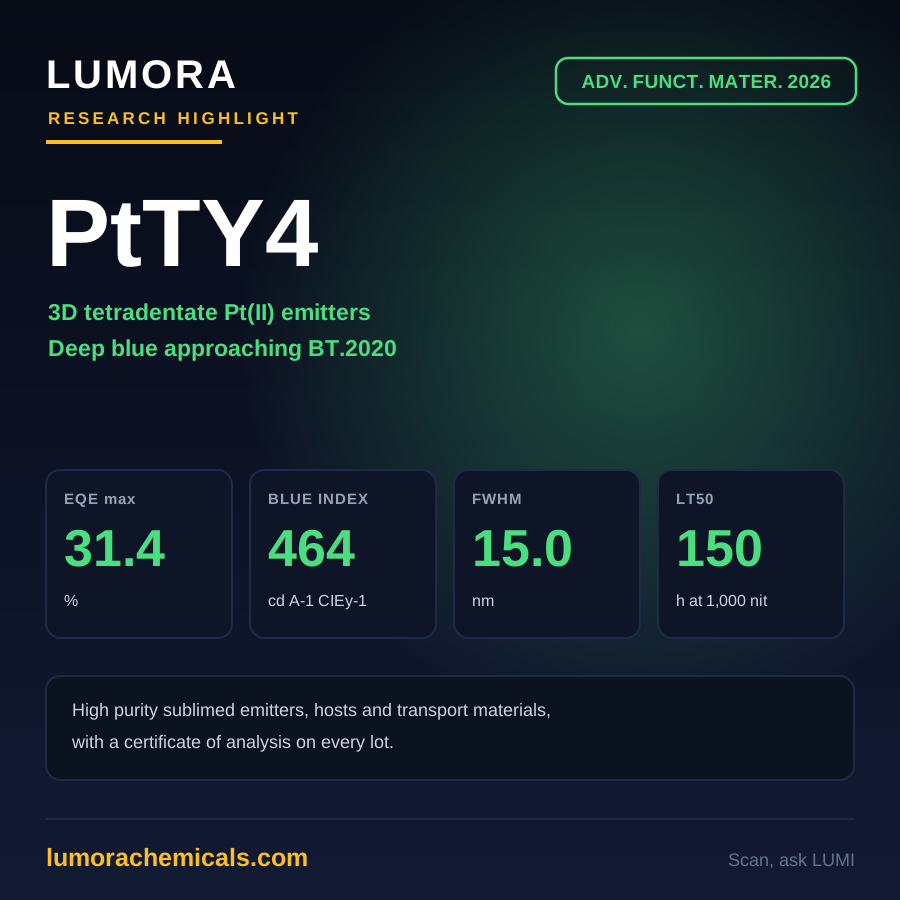
At LUMORA, we value deep-blue emitter platforms that solve color purity, efficiency, brightness, and operating voltage together. This study develops a series of three-dimensional tetradentate Pt(II) phosphors, PtTY1–PtTY4, using sterically tailored chromeno[3,2-c]carbazole (CCz) units and a bulky penta-tert-butyl terphenyl group. The design promotes locally excited-state-dominated phosphorescence with controlled metal-to-ligand charge-transfer character, suppresses intermolecular interactions, and enables narrow deep-blue emission approaching the BT.2020 blue target in top-emitting OLEDs.
The Problem: Deep-Blue Phosphors Commonly Trade Color Purity for Efficiency
A practical deep-blue OLED must combine a low CIEy value, narrow emission, high efficiency at display brightness, low operating voltage, and useful lifetime. Tetradentate Pt(II) complexes can harvest all electrically generated singlet and triplet excitons, but conventional planar structures may suffer from intermolecular aggregation, broadened spectra, red-shifted emission, and triplet–triplet or triplet–polaron annihilation.
Achieving BT.2020-like blue is especially demanding because the target CIE coordinate is (0.131, 0.046). The authors address this by controlling both molecular geometry and excited-state composition rather than relying on color tuning alone.
The Breakthrough: Sterically Shielded 3D Pt(II) Geometry and 3LE-Dominated Emission
PtTY1–PtTY4 combine a rigid CCz-based tetradentate framework with different bulky substituents, dimethyl, cyclohexyl, adamantyl, and 2,7-di-tert-butylfluorenyl groups. These substituents create three-dimensional structures that suppress Pt–Pt, π–π, and host–guest interactions. Single-crystal structures of PtTY2–PtTY4 show no intermolecular π-stacking.
The CCz unit concentrates the lowest triplet excited state in a locally excited ³LE character while retaining a controlled ³MLCT contribution. This combination limits excited-state deformation and vibronic sidebands, while maintaining strong spin–orbit coupling and efficient phosphorescence. Increasing steric bulk reduces Huang–Rhys factors and narrows emission; PtTY4 produces the smallest room-temperature FWHM of 15.0 nm in toluene.
Key Results
Why This Matters for OLED Material Supply
For LUMORA, this work demonstrates a practical deep-blue Pt(II) design route: use sterically demanding, three-dimensional substituents to control packing and suppress vibronic broadening, while engineering a ³LE-dominated triplet state with sufficient ³MLCT character for efficient phosphorescence. The result is a platform capable of both high bottom-emitting efficiency and high-color-purity top-emitting OLED operation.
Relevant supply opportunities include Pt(COD)Cl₂ and related Pt(II) precursors, CCz and benzofurocarbazole ligand intermediates, bulky tert-butyl terphenyl and fluorene building blocks, NHC precursor chemistry, SiCzCz and SiTrzCz2 host materials, HATCN, TAPC, mSiTrz, Liq, and LiF for bottom-emitting stacks, plus BFSFA, FCN, BTrzTPCN, Yb, Ag:Mg, and BPNBNBA for top-emitting architectures. The PtTY4 system highlights how molecular steric design can produce a blue-index value roughly twice that of commercial deep-blue fluorescent OLEDs while moving chromaticity close to BT.2020.
LUMORA, research to pilot
High purity sublimed emitters, hosts and transport materials, with a certificate of analysis on every lot.
Visit LUMORA →Custom synthesis and supply
Gram to production scale, custom synthesis of new emitters, and full CRDMO support. NDA first.
Open LUMI workspace →Partner with us