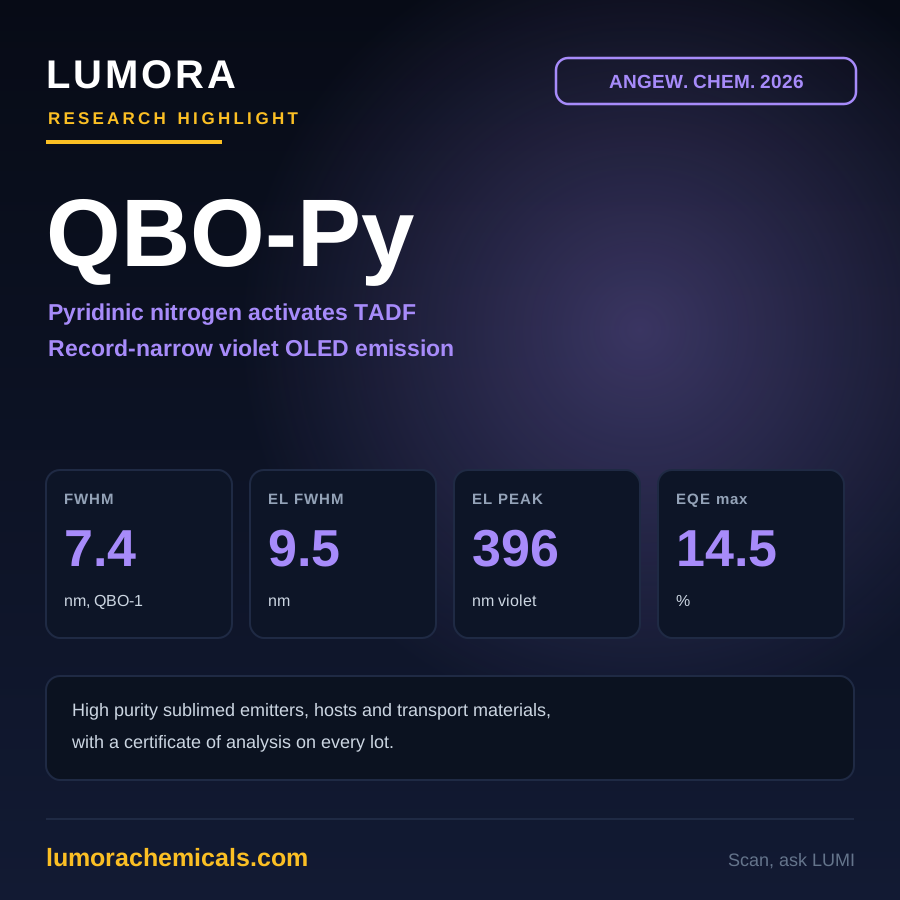
At LUMORA, we value molecular platforms that pair exceptional spectral purity with routes suitable for scalable material development. This work introduces QBO-1 and QBO-Py: tetraboron, boron–oxygen-covalent-bond-integrated polycyclic aromatic hydrocarbons synthesized through a methoxy-directed, lithium-free one-shot borylation. The pyridinic-nitrogen derivative QBO-Py activates thermally activated delayed fluorescence while preserving ultra-narrow violet emission, providing a route to OLEDs with both high color purity and improved exciton utilization.
The Problem: Multi-Boron PAHs Are Difficult to Make and Often Inefficient
Embedding multiple boron atoms in a polycyclic aromatic hydrocarbon can strengthen the multiple-resonance effect, reduce vibronic broadening, and produce exceptionally narrow emission. However, conventional tandem bora-Friedel–Crafts routes often suffer from complicated procedures, poor selectivity, byproducts, low yields, and difficult purification.
Boron–oxygen-integrated PAHs offer a promising alternative because methoxy groups can direct selective B–O bond formation. Yet many reported systems retain pronounced spectral shoulders and large singlet–triplet gaps, which prevent efficient reverse intersystem crossing and triplet harvesting. The authors address both limitations by integrating four boron atoms through B–O covalent bonds and replacing one central aromatic carbon with pyridinic nitrogen.
The Breakthrough: Pyridinic Nitrogen Tunes Triplet States
The authors develop QBO-1 and the pyridine-containing analogue QBO-Py through a methoxy-directed, halogen- and lithium-free one-shot tetraborylation route. The approach gives the key materials in yields up to 60% on gram scale, while the molecular precursors are assembled using standard Suzuki–Miyaura and Buchwald–Hartwig coupling steps.
In QBO-Py, the pyridinic nitrogen strengthens the multiple-resonance effect, suppresses high-frequency C–H rocking vibrations, lowers the singlet–triplet gap, and activates reverse intersystem crossing. This produces a clear TADF pathway that is absent in QBO-1. The rigid, planar frameworks and sterically twisted mesityl groups also suppress structural relaxation and detrimental intermolecular π-stacking.
Key Results
Why This Matters for OLED Material Supply
For LUMORA, this paper demonstrates a practical route toward ultra-narrowband violet and near-UV organic emitters: methoxy-directed B–O tetraborylation offers a simpler alternative to lithium-mediated multi-step synthesis, while pyridinic-nitrogen embedding simultaneously modifies the excited-state landscape and improves color purity by suppressing vibronic shoulders.
Relevant supply opportunities include methoxy-functionalized aromatic building blocks, mesityl-protected amine precursors, boron tribromide and other electrophilic borylation reagents, Suzuki–Miyaura and Buchwald–Hartwig coupling intermediates, high-triplet-energy mCP host materials, and TAPC, PPT, TmPyPB, LiF, and Al for multilayer violet OLED stacks. The QBO-Py result illustrates a central design principle: nitrogen incorporation can convert a color-pure but fluorescence-limited multi-boron PAH into an ultra-narrowband TADF emitter with substantially stronger OLED efficiency.
LUMORA, research to pilot
High purity sublimed emitters, hosts and transport materials, with a certificate of analysis on every lot.
Visit LUMORA →Custom synthesis and supply
Gram to production scale, custom synthesis of new emitters, and full CRDMO support. NDA first.
Open LUMI workspace →Partner with us