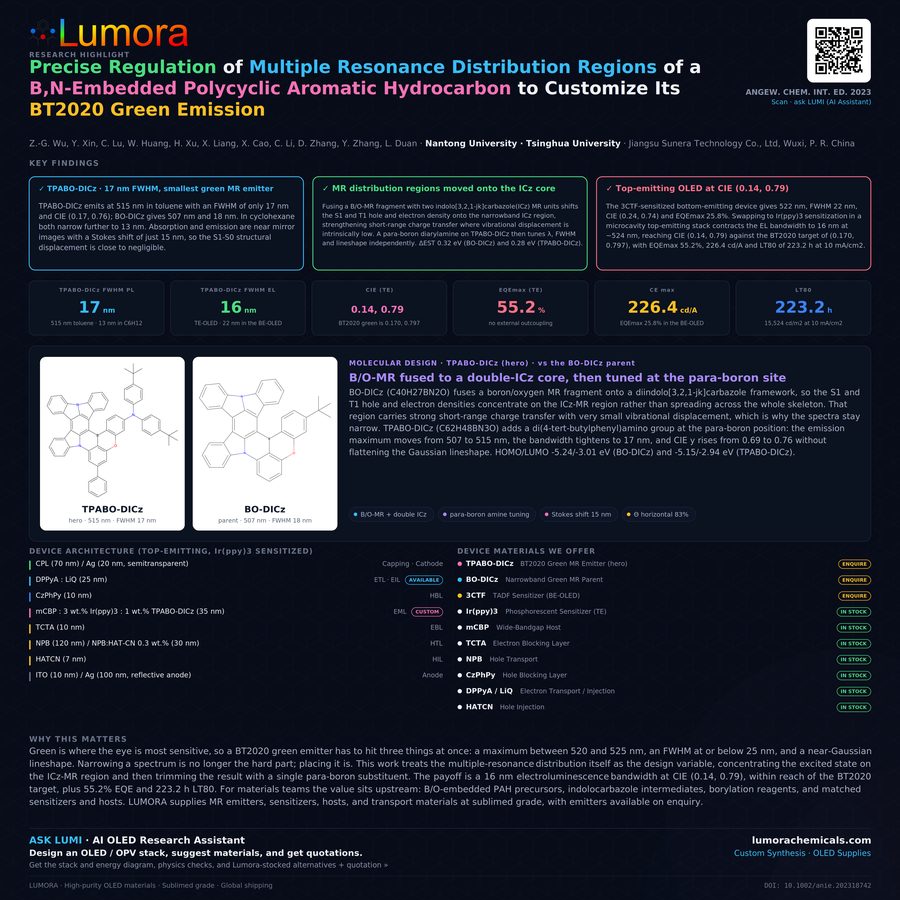
At LUMORA, BT.2020 green remains one of the most demanding targets in display materials. Green sits near the peak of human visual sensitivity, so even small spectral deviations affect perceived purity and color-gamut coverage. This work demonstrates that molecular architecture can be engineered not only to narrow a spectrum, but also to shape it precisely around the wavelength and chromaticity region needed for next-generation displays.
The Challenge: BT.2020 Green Needs More Than a Narrow Peak
A practical BT.2020 green emitter must combine an emission maximum around 520-525 nm, FWHM at or below 25 nm, and an approximately Gaussian spectral shape. Earlier MR emitters delivered narrow green electroluminescence but often had a peak that was too blue or red, a broader tail, or insufficient CIE y to approach the BT.2020 target. The key challenge is to optimize wavelength, bandwidth, and lineshape simultaneously without sacrificing efficiency or stability.
The Breakthrough: Regulating MR Distribution Regions
The authors fuse a B/O-MR fragment with an indolocarbazole-based MR region to create BO-DICz and then TPABO-DICz. Electronic-structure calculations show that the S1 and T1 hole and electron distributions increasingly localize on the narrowband ICz-MR fragment, producing stronger short-range charge-transfer character where vibrational displacement is intrinsically low. Peripheral substitution at the para-boron position then fine-tunes the emission maximum and suppresses unfavorable vibrational modes, enabling a very narrow and spectrally well-shaped green output.
Emitter Platform: BO-DICz vs TPABO-DICz
Key Results
Why This Matters for OLED Material Supply
For LUMORA, this paper provides a clear roadmap for high-value ultrapure-green material systems: integrate B/O and ICz MR domains to concentrate the exciton on a narrowband resonance region, use precisely placed peripheral substituents to tune the final spectral profile, and pair the terminal MR emitter with an optimized sensitizer and optical cavity stack. The supply opportunity includes high-purity B/O-embedded PAH precursors, indolocarbazole intermediates, lithiation-borylation reagents, wide-bandgap mCBP host, 3CTF TADF sensitizer, Ir(ppy)3 phosphorescent sensitizer, and transport materials for top-emitting OLED architectures. The outcome is a practical materials platform that joins color-gamut leadership with high brightness and meaningful operating lifetime.
LUMORA, research to pilot
High purity sublimed emitters, hosts and transport materials, with a certificate of analysis on every lot.
Visit LUMORA →Custom synthesis and supply
Gram to production scale, custom synthesis of new emitters, and full CRDMO support. NDA first.
Open LUMI workspace →Partner with us