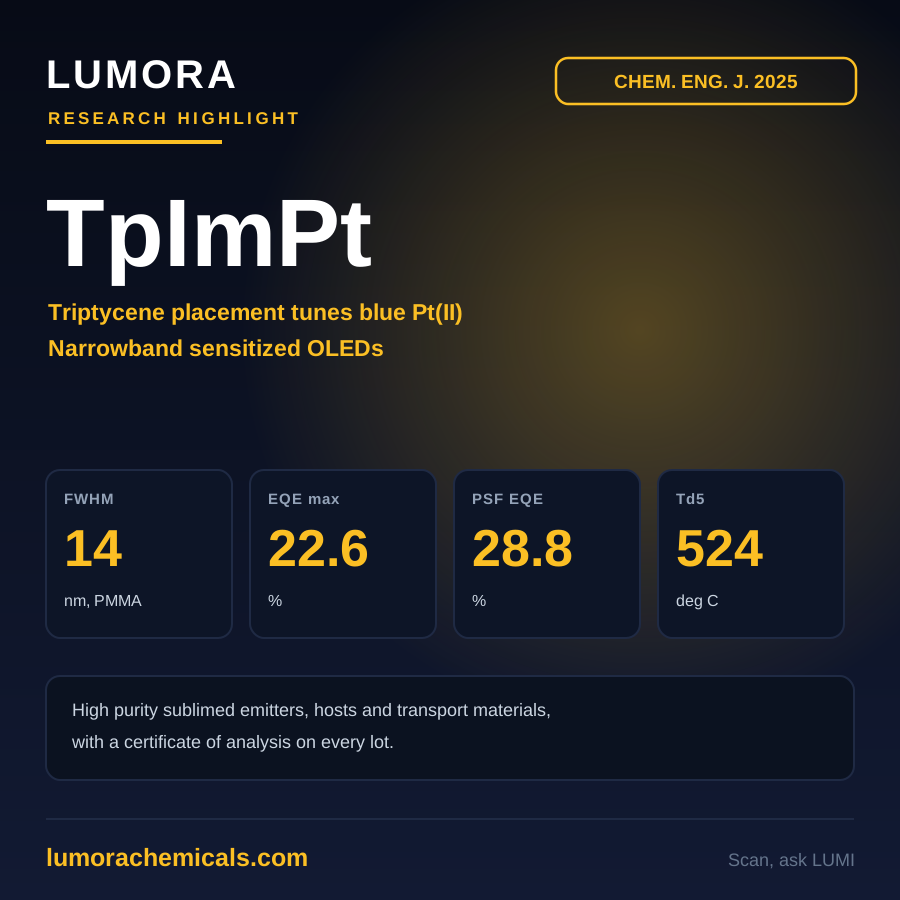
At LUMORA, we value molecular designs that balance emission bandwidth, efficiency, and structural stability. This study compares two tetradentate Pt(II) complexes containing triptycene: TpImPt (1), with a pendant group, and MeImTpPt (2), with a fused unit. Both serve as blue phosphorescent emitters and as sensitizers for ν-DABNA. The pendant design provides narrower intrinsic emission and higher sensitized-device efficiency, whereas the fused design improves operational stability.
The Problem: Packing and Vibrations Broaden Emission
Square-planar Pt(II) complexes can interact with neighboring dopants or host molecules, forming aggregates or excimers that broaden spectra and reduce color purity. Bulky substituents can suppress these interactions, but the way they attach to the ligand also affects vibrational coupling. The authors investigate whether incorporating a rigid, three-dimensional triptycene unit as a pendant group or a fused backbone component produces different photophysical and device outcomes.
The Breakthrough: Pendant versus Fused Triptycene
Triptycene spatially shields the emissive Pt(II) framework. Both complexes preserve their emission profiles in PMMA up to 30 wt% loading and retain high PLQYs in the OLED co-host. However, fused triptycene does not automatically yield a narrower spectrum: MeImTpPt exhibits stronger high-frequency carbazole/pyridine vibrations and a more intense vibronic shoulder. Calculations identify predominantly ligand-centered triplet emission with small metal-to-ligand charge-transfer contributions. The fused complex also shows stronger calculated Pt–N bonding, consistent with its improved device stability.
Key Results
Why This Matters for OLED Material Supply
For LUMORA, the study offers a structure–property guide for developing Pt(II) emitters and phosphorescent sensitizers. Pendant triptycene favors narrower intrinsic emission and stronger PSF efficiency; fused triptycene favors higher direct-device EQE and improved PSF stability. Host selection remains critical: despite steric shielding, both phosphors broaden substantially in the exciplex co-host.
Relevant material categories include triptycene-functionalized aryl intermediates, NHC/imidazolium ligand precursors, pyridyl-carbazole building blocks, Pt(COD)Cl₂, SiCzCz/SiTrzCz2 co-hosts, ν-DABNA terminal emitters, and BCFN, HATCN, mSiTrz, Liq, and LiF transport/injection materials. These are research-relevant supply categories, not confirmed product availability. The broader lesson is to optimize sensitizer geometry, host compatibility, and terminal-emitter energy transfer together rather than judging a phosphor from solution linewidth alone.
sales@lumorachemicals.com
lumorachemicals.com
LUMORA, research to pilot
High purity sublimed emitters, hosts and transport materials, with a certificate of analysis on every lot.
Visit LUMORA →Custom synthesis and supply
Gram to production scale, custom synthesis of new emitters, and full CRDMO support. NDA first.
Open LUMI workspace →Partner with us