Home › Research Highlights › v-dabna-az-pure-blue
ADVANCED MATERIALS

Azepine-Decorated ν-DABNA Delivers Deep-Blue OLEDs with CIEy = 0.060, ≈30% EQE, and up to 300 h LT50

📅 September 16, 2026Mamada et al., Advanced Materials, 2024 , “Efficient Deep-Blue Multiple-Resonance Emitters Based on Azepine-Decorated ν-DABNA for CIEy below 0.06”
Azepine-Decorated ν-DABNA Delivers Deep-Blue OLEDs with CIEy = 0.060, ≈30% EQE, and up to 300 h LT50

At LUMORA, the challenge of deep-blue OLED materials is not simply reaching a low CIE y. A commercially useful emitter must place the emission peak near 460 nm for reasonable visual efficiency, keep the bandwidth below 20 nm to limit color-filter loss, harvest triplets efficiently, and maintain a meaningful operating lifetime. This study offers a concise chemical modification strategy that shifts ν-DABNA into a purer-blue region while retaining the performance strengths of its established MR-TADF core.

The Challenge: Blue-Shift without Sacrificing MR Performance

π-Extended ν-DABNA offers strong performance but emits near 465–469 nm, which shifts its chromaticity away from the most demanding deep-blue targets. Alternative blue-shifting approaches, including heteroatom replacement or fluorination, can broaden emission or raise durability concerns. The authors therefore seek a modification that selectively changes frontier-orbital energies and the emission wavelength while retaining the rigid multiple-resonance framework responsible for narrow emission, high PLQY, and TADF behavior.

The Breakthrough: Azepine as a Directional Donor

The tribenzo[b,d,f]azepine donor offers an asymmetric, conformationally distinct electronic structure. Its nitrogen lone pair is more strongly delocalized toward one phenyl component than in carbazole or triphenylamine analogues, which modifies the relevant orbital energies and produces the desired blue-shift. Calculations predict a ∼460 nm emission for ν-DABNA-Az1 and enhanced spin–orbit couplings relative to ν-DABNA; sterically protected versions, ν-DABNA-Az2 and ν-DABNA-Az3, are additionally designed to manage emitter–host and emitter–emitter interactions in the solid state.

Emitter Platform -ν-DABNA-Az1, ν-DABNA-Az2,ν-DABNA-Az3

Key Results

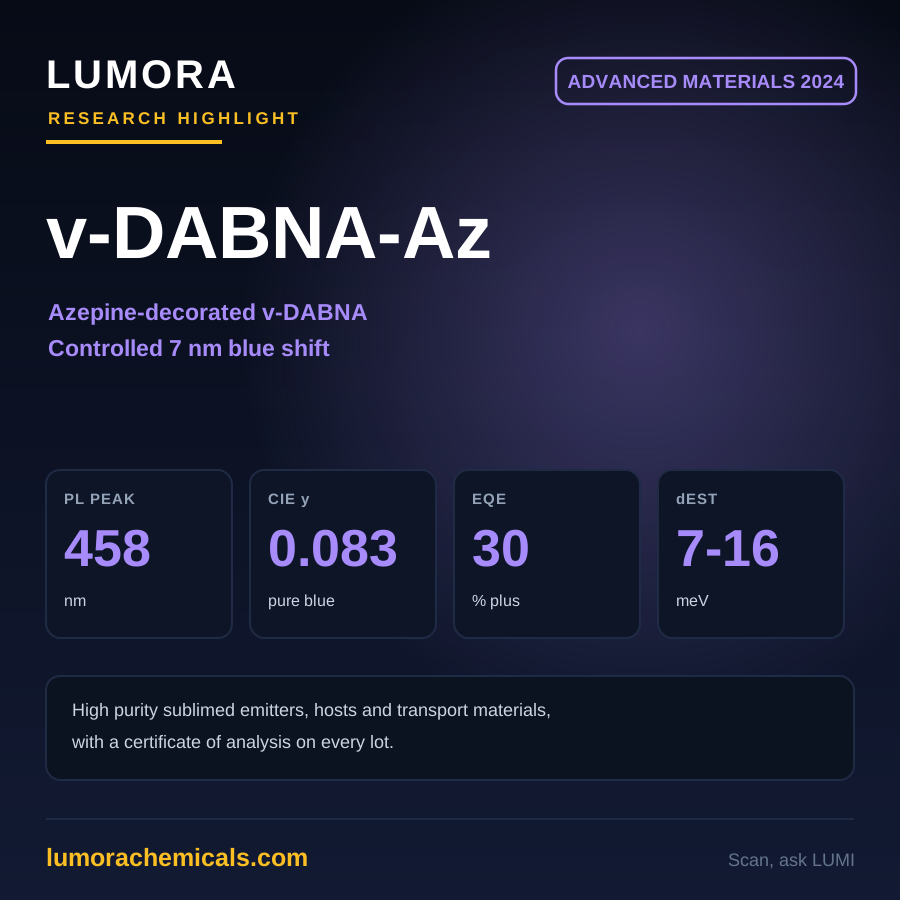
Controlled 7 nm blue-shift All three ν-DABNA-Az derivatives emit at 458 nm in 1 wt% PMMA films, compared with 465 nm for ν-DABNA under identical conditions. They retain FWHM values below 20 nm, showing that Az decoration moves color output without destroying the underlying MR spectral character.
Efficient MR-TADF retained The Az derivatives show PLQYs of 0.82-0.87, ΔEST values of 7-16 meV, and kRISC values of 2.3-3.4 × 10⁵ s−1. These kinetics remain comparable with ν-DABNA and are substantially faster than typical DABNA-1-based derivatives.
Pure-blue OLED color Devices using DOBNA-OAr host emit at 458-459 nm. ν-DABNA-Az1 achieves CIE (0.136, 0.083), while the sterically protected ν-DABNA-Az2 reaches CIE (0.140, 0.060), satisfying the cited EBU pure-blue definition and moving closer to BT.2020 blue.
High efficiency and power efficiency The developed OLEDs exceed 30% EQE and deliver roughly 20 lm W−1 luminous efficacy, together with low 3.0 V turn-on voltage. The narrow, appropriately positioned deep-blue band supports strong luminous efficacy despite the reduced eye sensitivity inherent to this spectral region.
Stability validates the Az design The ν-DABNA-Az3 device shows durability comparable to ν-DABNA despite its blue-shifted emission. Across the Az-decorated series, LT50 values reach up to 300 h at 100 cd m−2, estimated from acceleration aging tests, indicating that the azepine unit can be a robust deep-blue MR building block.

Why This Matters for OLED Material Supply

For LUMORA, this article demonstrates a flexible pathway for tuning existing high-efficiency MR-TADF platforms through donor substitution rather than wholesale core redesign. The approach creates demand across the material chain: ν-DABNA-type boron–nitrogen MR cores, tribenzoazepine donor intermediates, Buchwald–Hartwig amination components, borylation reagents for one-shot double cyclization, high-triplet-energy DOBNA-OAr hosts, and transport or injection materials for multilayer OLED stacks. The core message is commercially relevant: azepine substitution enables a deeper, narrower blue while preserving fast RISC, high device efficiency, useful power efficacy, and credible operational stability.

Reference: Mamada, M.; Aoyama, A.; Uchida, R.; Ochi, J.; Oda, S.; Kondo, Y.; Kondo, M.; Hatakeyama, T. Adv. Mater. 2024, 36, 2402905. “Efficient Deep-Blue Multiple-Resonance Emitters Based on Azepine-Decorated ν-DABNA for CIEy below 0.06.” https://doi.org/10.1002/adma.202402905
#OLED #MRTADF #DeepBlueOLED #nuDABNA #Azepine #PureBlue #NarrowbandEmission #CIEy006 #TADF #DisplayMaterials #LUMORA
Order the materials

LUMORA, research to pilot

High purity sublimed emitters, hosts and transport materials, with a certificate of analysis on every lot.

Visit LUMORA →
Scale up and CRDMO

Custom synthesis and supply

Gram to production scale, custom synthesis of new emitters, and full CRDMO support. NDA first.

Open LUMI workspace →Partner with us
Educational use notice. The Research Highlights on this site are shared for educational and informational purposes only. We summarise publicly available, published research to make it more accessible. All papers, figures, data, names and trademarks remain the property of their respective authors and publishers, and no ownership of the original work is claimed. If you are an author, publisher or rights holder and have any objection to any content shown here, please contact us at info@lamko.co.kr and we will remove, change or modify the content as per your instructions.